Direct rendering: shader GL on the GPU
ntk can draw a window's contents on the GPU with no pixels on the socket, no GL commands on the socket, and a modern shader pipeline instead of a fixed-function one.
This is the direct backend. The other one, indirect
GLX, serializes GL commands into the X connection and is
what ntk has always used. They are different pipelines with different APIs,
and which one a window gets is glPolicy — whose default is
still indirect, so nothing changes until you ask.
The direct backend comes in two flavors, one per platform, behind one
context contract and one gl API:
dri3(Linux): OpenGL ES 2 on a DRM render node, finished frames handed to the server as dma-buf descriptors over DRI3 + Present.appledri(macOS/XQuartz): the server exports the window's WindowServer surface over the Apple-DRI extension, and a CGL context draws straight into it — Apple's GL-on-Metal, ES2-compatible, so the same shaders compile.
Draw code does not choose between them: getContext('opengl') picks the
flavor for the platform, and everything below applies to both except where a
flavor is named. The Linux flavor is described first; macOS covers
what differs.
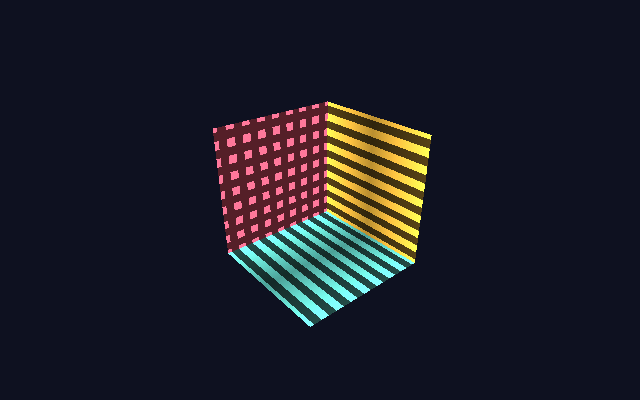
The pattern above is computed per fragment from the interpolated position — the kind of thing the fixed-function pipeline has no way to express, and the reason this backend exists.
const app = await createClient({ glPolicy: 'auto' });

const config = await app.chooseGLConfig({ DEPTH_SIZE: 24 });
const wnd = app.createWindow({
  width: 640,
  height: 480,
  visual: config.visual,
  depth: config.depth,
  backingStore: false // GL draws the window itself; it needs no pixmap
});
wnd.on('expose', draw); // see "Draw on expose" below
wnd.map();

const gl = wnd.getContext('opengl', config);
await gl.ready; // the whole path is proven, or this rejects with a reason
draw(); // an expose that raced `ready` had nothing to present into yet

function draw() {
  gl.makeCurrent();
  gl.viewport(0, 0, wnd.width, wnd.height);
  gl.clearColor(0.05, 0.06, 0.12, 1);
  gl.clear(gl.COLOR_BUFFER_BIT | gl.DEPTH_BUFFER_BIT);
  // ... shaders, buffers, draws ...
  gl.SwapBuffers();
}
How it works (the dri3 flavor)
GPU (DRM render node)                     X server
---------------------                     --------
draw with GL ES 2 into a GBM buffer
swap()  ->  dma-buf fd  --- fd over the unix socket (DRI3) --->  pixmap
Present.Pixmap(window, pixmap)  --------- flip or copy, at a vblank
                     <----- PresentIdleNotify  (the buffer is ours again)
The descriptor is passed once per buffer. Every later frame drawn into
that buffer is a single Present.Pixmap request naming a pixmap the server
already holds, so a frame costs one request whatever its resolution — the
test/gl-direct-live.test.js case that counts imports at the protocol seam is
there to keep it that way.
Three pieces have to be in place, and all three are checked before anything is created:
| piece | what it is | where it comes from |
|---|---|---|
x11-dri | the GPU context (GBM + EGL) and the dma-buf export | optional dependency, prebuilt for linux x64/arm64 |
| DRI3 | turns a dma-buf into a pixmap | the X server (Xorg + glamor, Xwayland) |
| Present | shows a pixmap, and says when its buffer is free | the X server |
x11-dri is a native addon, so ntk depends on it optionally: it is never
required to install or run ntk, nothing imports it until a policy asks for
direct rendering, and its absence is one of the reasons direct can be
false. Mesa's libgbm/libEGL/libGLESv2 are dlopen()ed at run time, so
there is nothing to rebuild when they change.
glPolicy
Set it on createClient, as a mode string or an object:
createClient({ glPolicy: 'auto' });
createClient({ glPolicy: { mode: 'auto', maxInFlight: 3 } });
| mode | meaning |
|---|---|
'indirect' | default — indirect GLX, the backend ntk has always used |
'auto' | direct where it is available, indirect otherwise |
'direct' | direct or nothing: getContext throws rather than quietly running a fixed-function pipeline instead |
'off' | no GL at all |
The default is not auto because the two backends expose different GL
APIs (below), and switching one under an app that never asked would break
its draw code. Opt in per app, or per run:
NTK_GL_POLICY=direct npm start # overrides whatever the app passed
The environment wins deliberately — its job is running one build both ways.
Object form knobs, over DEFAULT_GL_POLICY:
| key | default | meaning |
|---|---|---|
mode | 'indirect' | as above |
devicePath | null | which render node to draw on; null picks the first usable one |
maxInFlight | 2 | presents outstanding before a frame waits for a buffer |
linearFallback | true | retry a refused buffer once with a linear layout — see Buffer layout |
The three knobs below mode describe dma-buf machinery the appledri
flavor does not have — it ignores them silently.
Buffer layout
The buffers a frame is drawn into are GBM's own, and by default they carry whichever tiled layout the GPU prefers — the fast one, and the one two different pieces of software may disagree about. Two of them can refuse it, at opposite ends of the same buffer:
- EGL will not draw into it.
eglCreateWindowSurfaceover a render-only GBM surface answersEGL_BAD_MATCHon NVIDIA's driver, which wants a layout it can also scan out or one that is plainly linear. Nothing has been rendered yet; the context simply cannot be built. - The X server will not read it. The import lands on a server whose
display GPU is a different device, and the tiled layout means nothing to
it —
DRI3.PixmapFromBufferfails and there is nothing to show.
linearFallback (on by default) answers both with one retry: the generation
of buffers is made again as GBM_USE.RENDERING | GBM_USE.LINEAR, a layout
with no secrets in it, at the cost of some memory bandwidth. A generation
that went linear stays linear — whatever refused the tiled buffer has not
changed by the next resize — and a GL_CONTEXT_FAILED or
GL_IMPORT_FAILED naming both layouts means the retry was refused too.
Turning it off (glPolicy: { linearFallback: false }) is for finding out
that a machine is falling back rather than living with the bandwidth: the
refusal is then the error it was, with the layout it tried named in it.
What is available, and why not
const caps = await app.glCapabilities();
// { direct: true, indirect: true, flavor: 'dri3',
//   device: '/dev/dri/renderD128', reason: null }
// — and on macOS/XQuartz: { direct: true, flavor: 'appledri', device: null }
reason is an Error whose code is one of GLError — branch on the code,
not the message:
| code | meaning | remedy |
|---|---|---|
GL_NO_ADDON | x11-dri is not installed | npm install x11-dri |
GL_NO_DRIVER | the platform libraries are missing — libgbm/libEGL/libGLESv2 on Linux, libXplugin/OpenGL.framework on macOS — or the platform has no direct path | install Mesa / install XQuartz; elsewhere direct rendering does not exist |
GL_NO_DEVICE | no readable /dev/dri/renderD* (Linux) | map the device into the container, or join the render group |
GL_REMOTE_DISPLAY | a TCP or forwarded display | direct rendering is local-only; use indirect over a network |
GL_NO_FD_PASSING | local display, but this connection cannot pass a descriptor (dri3 flavor only) | under Bun, npm install x11@^4.1.0 — Node and Bun both pass descriptors, Deno neither |
GL_NO_DRI3 | the server has no DRI3/Present | Xvfb, Xephyr and XQuartz have none (XQuartz has its own path) |
GL_NO_APPLEDRI | macOS, and the server has no usable Apple-DRI | is the display an XQuartz server? |
GL_NO_WINDOWSERVER | macOS, but no WindowServer session — SSH | run from the logged-in GUI session |
GL_IMPORT_FAILED | the server refused the buffer | usually different DRM devices — set devicePath |
GL_CONTEXT_FAILED | GPU context setup failed | the message says what did |
GL_DISABLED | glPolicy: 'off' | — |
The probe runs during createClient() whenever the policy could choose
direct, which is what lets getContext() pick a backend synchronously
afterwards. Under the default policy it does not run at all, so an app that
never asked pays nothing for it — but it also means that raising the policy
after connecting needs one await app.glCapabilities() before a context can
be created.
Runtimes
The dri3 flavor needs a runtime that can send a file descriptor over a
unix socket, because that is how DRI3 hands the server a buffer. x11 has a
transport for each: Node's internal process.binding('pipe_wrap'), and
bun:ffi calling sendmsg(2) under Bun, which arrived in x11 4.1.0 and is
on by default. So:
| runtime | direct (dri3) | direct (appledri) | indirect |
|---|---|---|---|
| Node | yes | yes | yes |
| Bun | yes — bun:ffi sendmsg(2), from x11 4.1.0 | yes — no descriptor ever crosses the socket | yes |
ntk depends on x11 ^4.1.0, so a fresh install has that transport. An
older x11 resolved into the tree some other way still reports
GL_NO_FD_PASSING under Bun, and so does a runtime with neither transport —
Deno, today. 'auto' then falls back to indirect GLX, which needs no
descriptor passing at all, and nothing else about the display has to change.
The API is not the GLX one
| direct | indirect ('opengl') | |
|---|---|---|
| pipeline | OpenGL ES 2.0 (dri3) / desktop GL, ES2-compatible (appledri) | OpenGL 1.x fixed-function |
| naming | gl.clearColor, gl.drawArrays | gl.ClearColor, gl.Begin |
| shaders | yes, GLSL ES 1.00 | none — the protocol encodes no shader objects |
| geometry | VBOs, drawArrays/drawElements | immediate mode + display lists |
| reach | local connections, Linux or macOS/XQuartz, a GPU | any server allowing indirect contexts |
Code that runs on either branches on gl.backend, which is 'direct' or
'indirect':
if (gl.backend === 'direct') gl.clear(gl.COLOR_BUFFER_BIT);
else gl.Clear(gl.COLOR_BUFFER_BIT);
getContext('opengl') is the backend-neutral name and obeys the policy.
getContext('gles') asks for the Linux direct flavor by name and
getContext('cgl') for the macOS one; each throws where its flavor is not
the one available — useful when the code wants no silent substitution.
Direct contexts also carry gl.flavor ('dri3' or 'appledri') for the
rare code that cares which pipeline is under it.
The ES 2 surface is whatever x11-dri exposes: the core of ES 2 — shaders,
programs, uniforms, buffers, attributes, draws, textures, framebuffer
objects, renderbuffers, blending, scissoring, readPixels — plus the ES 3
entry points a driver has (VAOs, instancing, 3D textures), which
gl.getFeatures() reports. Still absent, and the reason
Multisampling has nothing to resolve by hand:
renderbufferStorageMultisample and blitFramebuffer. Adding an entry point
is a small wrapper in that package.
Context lifetime
- One GPU context per app and pixel format on the
dri3flavor. Programs, buffers and other GL objects are shared between surfaces on a connection, the way they are between canvases in a browser tab, and exactly one surface is current at a time. (Theappledriflavor owns one CGL context per window instead — see macOS; code that caches GL resources by theglobject identity is correct on both.) gl.makeCurrent()binds this context's surface and picks up a resize — call it at the top of every frame. Individualgl.*calls also bind if another surface stole currency, so a stray call cannot draw into the wrong window.gl.destroy()releases the surface, its pixmaps and its event selection. The shared GPU context belongs to the connection and is released byapp.close().gl.onError = fnis called once, with the coded errorgl.errorthen holds, when a context that wasreadyfails — a swap the driver refused mid-life. A failure beforereadyresolved is its rejection, and only that. Either way the context draws nothing more, so a caller with a fallback shows it on whichever of the two it hears. Both flavors.- A resize is a new generation of buffers, made at the top of the next
frame by
gl.makeCurrent(), and the old generation's surface is unbound before it is destroyed. The order is load-bearing on NVIDIA's driver: a surface destroyed while it is current left every later swap failing withEGL_BAD_SURFACE.
Frames and back pressure
-
gl.SwapBuffers()(orgl.swapBuffers()) shows the frame just drawn. It returnsfalsewhen the frame could not go out because every buffer is still with the server. -
gl.canRender()is the same question asked before drawing, andgl.onFrameAvailable = fnfires when the answer becomes yes again. A draw loop that respects both never renders frames that have nowhere to go:gl.onFrameAvailable = () => wnd.requestAnimationFrame(draw);function draw() {if (!gl.canRender()) return; // onFrameAvailable will call back// ... draw ...gl.SwapBuffers();wnd.requestAnimationFrame(draw);} -
Presents are sent with
targetMsc: 0and noOption.Copy, so the server shows them at the next vblank and may flip rather than copy. Frame pacing is still the window's frame clock (window.md); the swap chain only bounds how many frames can be in flight. -
The
appledriflavor keeps the same contract with different machinery underneath: there is no swap chain and the server applies no backpressure, so eachSwapBuffers()closes thecanRender()gate itself for one display period andonFrameAvailablereopens it. A loop written as above runs at ~display rate on both flavors.
Draw on expose
A Present to a window that is not yet viewable is discarded — there is
nowhere to put it — so a frame drawn immediately after map() never appears,
and a window that gets uncovered has nothing to redraw itself from. A GL
window has no backing store to serve those from, which is why every GL app
draws on expose:
wnd.on('expose', draw); // adding the listener is what selects Exposure
wnd.map();
macOS
XQuartz never implemented DRI3 — its direct rendering is the Apple-DRI extension, and it runs the transfer the other way round. Where DRI3 is client-allocates-and-pushes, Apple-DRI is server-exports-and-attaches:
this process                              X server (XQuartz)
------------                              ------------------
apple.clientId()  --- AppleDRICreateSurface(win, cid) --->  exports the
                  <-------------- key[2] ----------------   window's surface
ctx.attach(key)      (import surface + bind a CGL context)
gl draws straight into the window's backing store
ctx.flush()          (CGLFlushDrawable — the WindowServer composites)
                  <--- AppleDRISurfaceNotify ------------   moved / resized /
                                                            destroyed
After the attach, nothing crosses the X socket per frame — no pixels, no
descriptors, no requests. Rendering is the real GPU (Apple's GL-on-Metal;
gl.renderer reports the chip), and the same gl API and the same GLSL ES
1.00 shaders as the Linux flavor. The pieces:
| piece | what it is | where it comes from |
|---|---|---|
x11-dri >= 0.5.0 | the WindowServer handshake, the surface import and the CGL context | the same optional dependency, prebuilt for macOS arm64 |
| Apple-DRI | exports a window's surface to a local process | the X server — XQuartz only |
| a GUI session | the WindowServer connection surfaces are imported into | log in at the machine; SSH sessions report GL_NO_WINDOWSERVER |
The protocol half — the requests, the reply layouts and the
AppleDRISurfaceNotify event — is pure JS in lib/appledri.js; the halves
that cannot be (Xplugin, CGL) are the addon's dri.apple namespace.
What differs from the dri3 flavor, beyond the wire:
- The surface exists only while the window is mapped. The context is
created synchronously and
gl.*works immediately (shaders compile, FBOs render), butgl.readysettles — andcanRender()first turns true — aftermap(), when the server has a physical window to export. Unmapping destroys the surface (AppleDRISurfaceNotifysays so) and the context re-attaches by itself on the next map. The draw-on-expose pattern above absorbs all of this without extra code. - One CGL context per window, not a shared one per app: a CGL context
attaches to exactly one surface. GL resources are therefore per-window on
this flavor; cache them by the
globject identity and both flavors are handled. - The GL dialect is desktop 4.1 core with
ARB_ES2_compatibility, not ES: GLSL ES 1.00 sources compile unchanged (the addon injects#version 100where a source has no version line), ES3-class entry points (VAOs, instancing) exist, but#version 300 esshaders do not compile — ES 3.00 shading is Linux-only today. - Verify pixels with
gl.readPixels, notGetImage. The GL surface is composited by the WindowServer above the X framebuffer, so X-side reads of a GL window —GetImage, screenshots of the X screen — show stale contents by design. - A stencil buffer by default — 8 bits, as the Cocoa backend's GL
surfaces have, where the
dri3flavor has none. See Stencil. - Depth-32/ARGB windows are untested on this flavor (XQuartz typically
publishes no 32-bit visual, so
chooseGLConfig({ ALPHA_SIZE: 8 })fails there withGL_CONTEXT_FAILED).
Choosing a window to draw into
app.chooseGLConfig(spec) answers for whichever backend the policy picked,
in GLX's attribute vocabulary either way, so the call site does not have to
be written twice:
const config = await app.chooseGLConfig({ DEPTH_SIZE: 24 });
// { backend: 'direct', visual, depth, class, doubleBuffer, depthSize,
//   stencilSize, samples, screen, fbconfig: null, device, config: {} }
On the direct backend it needs no round trip — there are no fbconfigs, only a
window whose depth the GPU's buffers can be read as. DEPTH_SIZE becomes the
depth-buffer size of the flavor's context (EGL on dri3, CGL on appledri)
and STENCIL_SIZE its stencil size where the flavor can ask for one — see
Stencil below; ALPHA_SIZE picks a 32-bit ARGB visual (whose
alpha a compositor blends) instead of the root's 24-bit one. SAMPLES and
SAMPLE_BUFFERS are answered rather than honoured — see
Multisampling below. Everything else in the spec is ignored
there, and honoured by
chooseGLXConfig on the indirect one.
samples is on the answer from either backend, and is the one field to
branch on: the colour samples per pixel the config really has, 0 for none.
stencilSize sits beside it and answers the same way for stencil bits.
(chooseGLXConfig reports null for both in the one case where it cannot
know — a spec that pins visual, where no fbconfig is looked at.)
Multisampling
The direct backend cannot give a window a multisampled buffer today, on
either flavor, and chooseGLConfig says so instead of dropping the request:
the config it returns has samples: 0, and a spec that asked for more warns
once per connection.
const config = await app.chooseGLConfig({ SAMPLES: 4 });
if (config.samples < 4) {
  // draw at 2x into an FBO and downsample, or accept aliased edges
}
The reason is one layer below ntk. A sample count belongs to the pixel format
the x11-dri addon builds — EGL_SAMPLES on the EGLConfig behind the GBM
surface (dri3), kCGLPFASamples on the CGL pixel format (appledri) — and
the addon takes a depth size and no sample count, so there is nothing here to
ask with. Its GL table has neither renderbufferStorageMultisample nor
blitFramebuffer either, so ntk cannot resolve a multisampled framebuffer by
hand in place of the driver. When the addon grows the option, samples
becomes what it reports and the same spec starts meaning what it says
(DIRECT_SAMPLES in lib/gl.js is the single place that changes).
What works today:
- Indirect GLX honours it.
SAMPLES/SAMPLE_BUFFERSare fbconfig attributes there, matched as minimums, so a server with multisample fbconfigs gives real MSAA — and a server without one now fails the call rather than quietly returning a visual with no sample buffers. - Supersample in your own draw code. Render to an FBO at 2x and downsample. One bilinear tap resolves a 2x supersample and no more, so past 2x this needs a mip chain or a multi-tap filter to keep gaining.
gl.samplescarries the same number on the context —'opengl','gles'and'cgl'alike — for draw code that has no config in hand.
Stencil
A direct window on macOS has an 8-bit stencil buffer unless the config asks
otherwise; on Linux it has none. STENCIL_SIZE in the spec (or
stencilSize on a config) asks for a size where the flavor can pass one on,
and stencilSize on the answer — and gl.stencilSize on the context — says
what the window has:
| backend | the spec names no size | STENCIL_SIZE: n |
|---|---|---|
appledri | 8 | at least n — kCGLPFAStencilSize on the CGL pixel format; 0 asks for none |
dri3 | 0 | still 0, and a warning once per connection |
| indirect | whatever the chosen fbconfig has | an fbconfig with at least n |
The macOS default is what the Cocoa backend's GL surfaces carry (DEPTH24_STENCIL8), so a GL window has the same buffers on either macOS path, at next to no cost. The CGL context used to be created with a depth size only, and so had no stencil buffer at all.
Check the number, not the request, because a framebuffer with no stencil
buffer passes every stencil test. Stencil-based drawing — a
stencil-then-cover polygon fill, a clip mask — does not fail there; it draws
everywhere its cover geometry reaches. A probe that writes 1s and then draws
where the stencil is 1 cannot tell the two apart, since that draws either
way. One that can: draw with gl.NOTEQUAL, 0 over a stencil just cleared to
0 — a real buffer fails every fragment, so nothing is drawn.
const config = await app.chooseGLConfig({ STENCIL_SIZE: 8 });
const gl = wnd.getContext('opengl', config);
if (gl.stencilSize < 8) {
  // render into a framebuffer of your own with a DEPTH24_STENCIL8
  // renderbuffer attached, then copy the result to the window
}
The dri3 flavor cannot ask for one because the stencil size belongs to the
EGLConfig the x11-dri addon builds, and its Gpu takes a colour format and
a depth size only; EGL sorts configs smallest stencil first, so there is no
stencil buffer to count on. When the addon grows the option,
directStencilSize in lib/gl.js is the single place that changes.
Testing
test/gl-policy.test.js covers the decisions — policy resolution, the client
probe, capability gating, error codes, flavor dispatch — hermetically, with
the addon stubbed, so it runs with no display and no GPU;
test/gl-samples.test.js and test/gl-stencil.test.js check what a spec's
sample and stencil requests become on each backend the same way, and
test/appledri.test.js checks the Apple-DRI wire encoding. The live halves
skip wherever their path is unavailable, which includes CI (Xvfb has neither
DRI3 nor Apple-DRI): test/gl-direct-live.test.js renders a shader-drawn
triangle over DRI3 and reads the window back with GetImage;
test/gl-appledri-live.test.js does the same against XQuartz and verifies
with gl.readPixels (see macOS for why not GetImage), stencil
probe included.